Montgomery County gives buyers something a lot of suburban markets don't: real choices. Bethesda and Kensington sit just outside the District's limits, and while they share a county and a general price range, they're genuinely different places to live. Different housing density, different transit setups, different daily rhythms. Buyers interested in living in Bethesda, MD should weigh these factors carefully.
Both attract buyers who want proximity to Washington, D.C. without being in it. But once you get past that shared appeal, the details start to diverge - and for most buyers, those details are exactly what decides it.
The median home price in both areas clears $1 million without much effort, but the housing stock and commute logistics vary enough that treating these two as interchangeable would be a mistake. Before you start scheduling tours, it's worth understanding what each one actually offers.
Comparing Home Prices and Housing Options
Both markets command premium prices. Most single-family homes sell well above the county median, and buyers should expect competition rather than the other way around.
Bethesda currently has around 236 available homes - a meaningful inventory pool by this area's standards. The median sale price sits at approximately $1,375,000, properties spend roughly 24 days on the market, and over 42% of homes sell above list price. If you're targeting updated listings here, plan accordingly.
Kensington runs smaller in every sense. The median sale price is around $1.2 million, which represents a notable year-over-year increase, and the overall number of available homes is lower than in Bethesda. What's there tends to move quickly.
What to Expect in Kensington
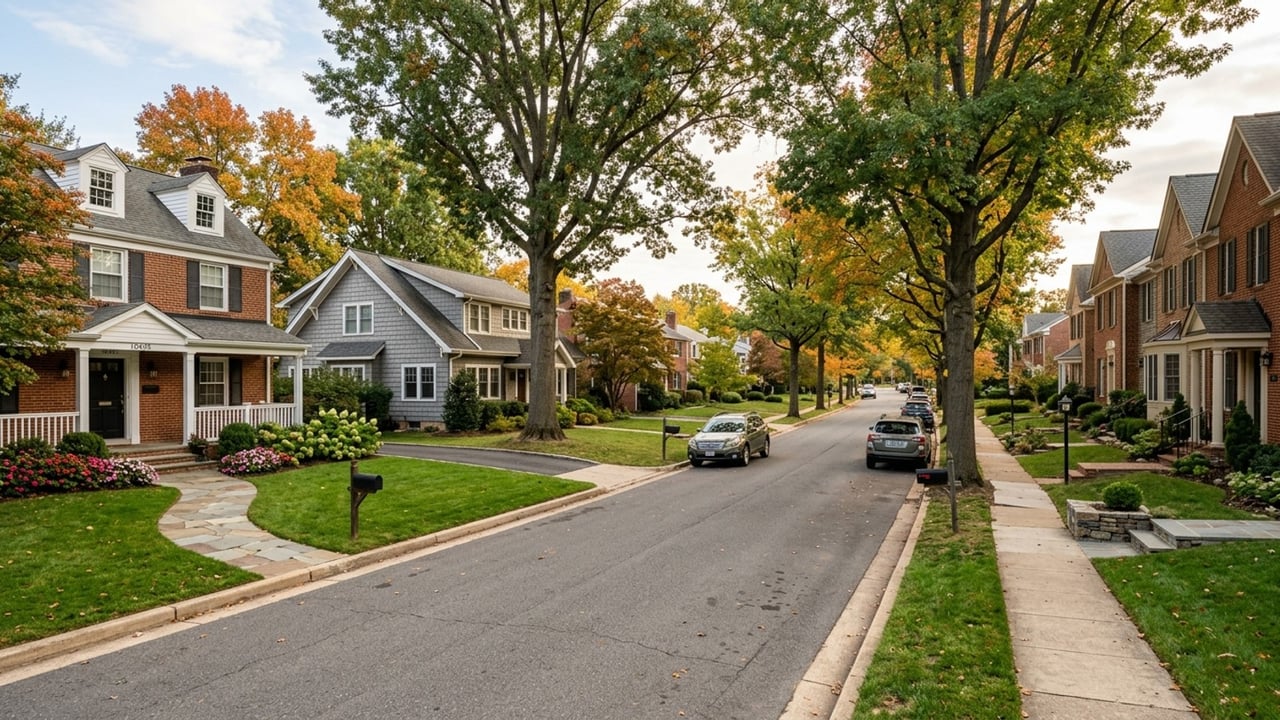
Kensington's housing stock includes single-family homes, townhouses, and condos, spread across a quieter residential layout where properties often sit on established lots. Buyers who specifically want lower-density streets tend to gravitate here.
That $1.2 million median can make a difference. For some buyers, it's the margin between a detached home and a townhouse - a home that would be priced noticeably higher just a few miles away in Bethesda.
What to Expect in Bethesda
Bethesda's range is wider. On one end, you have high-rise condominiums near the Metro. On the other, you have large detached homes in neighborhoods like Edgemoor, Bradley Hills, Kenwood, Burning Tree, and Woodhaven. The concentration of condos and townhomes gives buyers who want walkable urban access a real path in. The detached single-family homes, though, are what push the median up to that $1,375,000 figure.
Getting to Washington, D.C. and Beyond
For most buyers in this price range, commute logistics aren't an afterthought - they're a deciding factor. Both areas get you to Washington, D.C., but they do it through completely different systems.
Driving from either location means the Capital Beltway (I-495) or local arterial roads. From Kensington, a drive into the city runs 21 to 32 minutes depending on traffic and your specific destination. The transit picture is where the real differences show up.
Transit Options in Kensington
Kensington is served by the MARC Train's Brunswick Line at the Kensington station - 15 scheduled weekday stops, with a direct trip to Union Station in about 38 minutes. For local travel, residents use the Montgomery County Ride On bus service. A combined bus-and-subway trip into Washington, D.C. from Kensington runs approximately 33 minutes.
It works, but it requires more planning than a Metro-connected address.
Transit Options in Bethesda
Bethesda connects directly to the WMATA Metro Red Line at Bethesda station, with a typical rail commute into Washington, D.C. of 20 to 25 minutes. The station also anchors Metrobus routes D96, M22, and M70, along with Ride On buses 29, 30, 32, 34, 36, 47, and 70. The Bethesda Circulator and Fairfax Connector route 798 round out the local options. Down the road, the Purple Line light rail will connect at Bethesda station as well, with service expected to begin in late 2027.
Shopping, Dining, and Walkability
These two areas feel different on a Tuesday afternoon, and that's worth understanding before you commit.
Both offer grocery stores, local dining, and daily services within Montgomery County. The gap is in scale and density - and that gap is significant.
Walkability here is almost entirely a function of how close you are to the commercial core. If pedestrian access to restaurants and retail matters to you, where exactly within either area you buy matters just as much as which area you choose.
Commercial Districts in Kensington
Kensington's commercial footprint is small and local. The retail serves the immediate residential population - daily necessities, independent businesses - and residents typically drive to nearby areas for larger shopping. The town's layout reflects a clear priority: residential space over large-scale commercial development. That's not a criticism; for some buyers, it's exactly what they're looking for.
Bethesda Row and Local Businesses
Bethesda's downtown is a different category entirely. Bethesda Row concentrates dining, retail, and entertainment in a way that Kensington simply doesn't. Neighborhoods immediately surrounding that district - Edgemoor among them - offer genuine walkability to those amenities. The Capital Crescent Trail also runs through the area, giving pedestrians and cyclists a paved route through the corridor.
Deciding Which Area Fits Your Goals
There's no wrong answer here, but there is an answer that fits your situation better than the other one.
If direct Metro Red Line access and proximity to a dense commercial district like Bethesda Row are requirements, Bethesda is your market - at a median of around $1,375,000 and with real competition on desirable listings. If a slightly lower median entry point of $1.2 million works for your budget and you can build your commute around the MARC train, Kensington is worth a serious look.
The most useful thing you can do at this stage is tour homes in both areas back to back. Lot sizes, street feel, and neighborhood layout don't translate through a listing description. You have to see it.
Frequently Asked Questions
How much more expensive is it to buy a single-family home in Bethesda compared to Kensington?
Bethesda is generally the pricier market. The median sale price there is approximately $1,375,000 versus around $1.2 million in Kensington. Exactly what you'll pay depends on lot size, location within each area, and the condition and updates of the specific home.
Which neighborhood offers a faster commute into Washington, D.C., Bethesda or Kensington?
Bethesda, typically. The Metro Red Line from Bethesda station runs about 20 to 25 minutes into the city. The MARC train from Kensington to Union Station takes about 38 minutes - a direct trip, but a longer one.
Do Kensington neighborhoods feed into the same Montgomery County public school clusters as Bethesda, MD?
Not necessarily. Both are in Montgomery County, but school boundaries vary by neighborhood and specific address. Check the district's boundary map for exact assignments before drawing any conclusions.
What is the main difference in community vibe and walkability between downtown Bethesda and Kensington?
Bethesda is denser and more urban, anchored by major commercial districts like Bethesda Row. Kensington has a smaller commercial footprint and a quieter residential character - most residents drive for larger shopping trips. They're genuinely different environments day to day.
Are there stricter rules for renovating a house in Kensington's historic district than in Bethesda?
It depends on where the property sits. A home located within a designated historic district will be subject to specific local regulations governing exterior renovations. Verify the historic status of any property you're considering with the municipality before you're under contract.
Are property taxes or local municipal fees different if I buy in the Town of Kensington instead of unincorporated Bethesda?
Yes, they can be. Incorporated towns often levy their own local taxes or fees on top of the standard Montgomery County property tax. Pull the specific tax record for any home you're seriously considering - don't assume the county rate tells the whole story.